Compass: Goal Points vs Joon: Which Family Points App Fits Your Kids?
Compass: Goal Points vs Joon compared on ages, how points work, rewards, consequences, and price. Here's which family app fits younger kids vs tweens and teens.
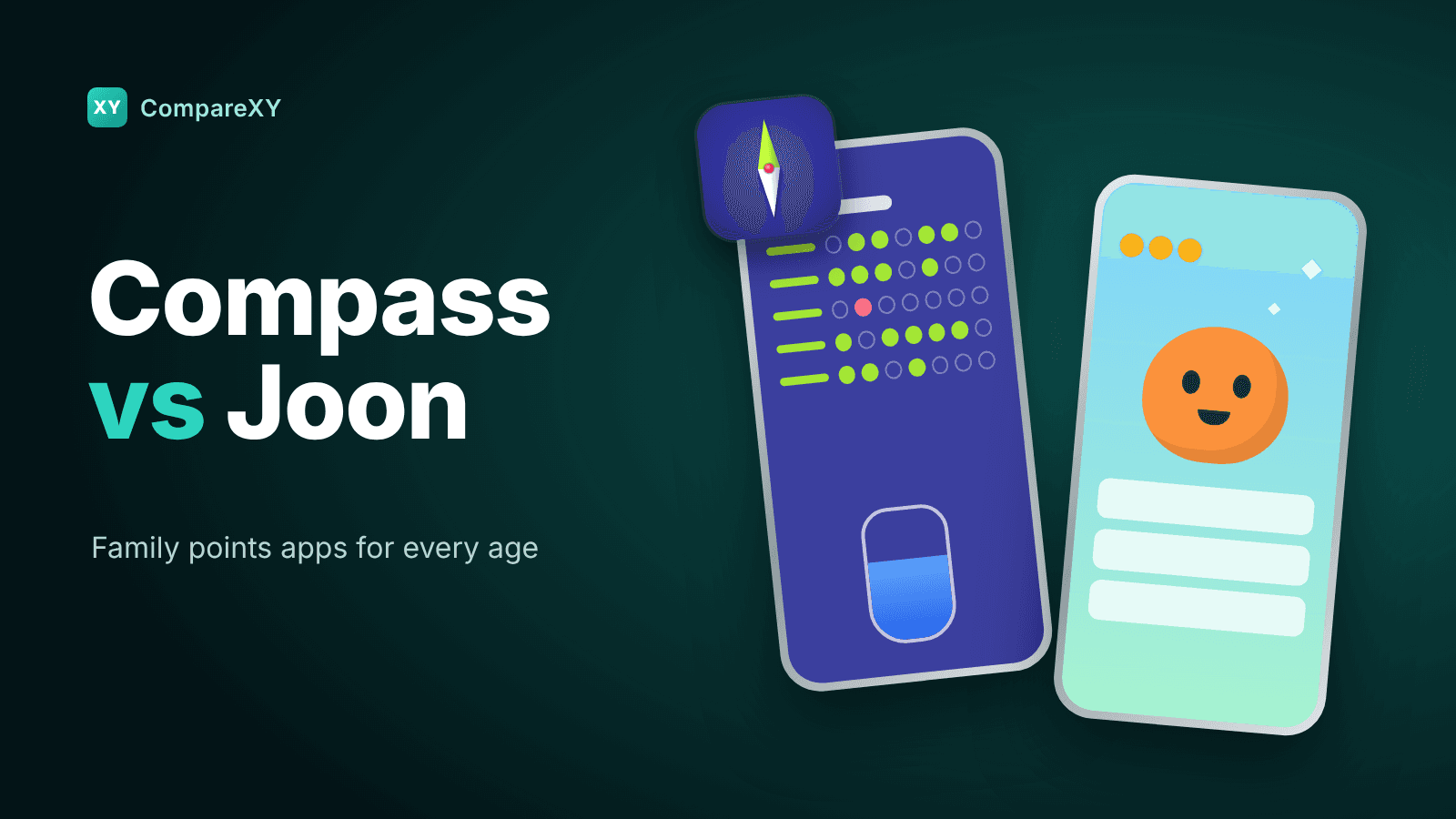
Note: I made Compass: Goal Points. Full disclosure at the end of this post.
Both Compass: Goal Points and Joon help parents motivate kids to do the things that matter — chores, homework, routines, behavior. But they take very different approaches.
Here's the short answer:
For kids around 6–10 who need a game to stay motivated, choose Joon.
For tweens and teens working toward a real goal, with clear points for good choices and for bad ones, choose Compass: Goal Points.
Joon turns responsibilities into a video game. Compass turns them into a points system the whole family can see, aimed at a real reward.
Executive Summary
Choose Joon if:
- Your child is roughly 6–10 and loves video games
- You want tasks to feel like quests, with a virtual pet as the motivator
- You'd like to start with a free version
- Your child has ADHD or struggles with routines — Joon is built with those families in mind
Choose Compass: Goal Points if:
- Your child is a tween or teen who would find a virtual pet babyish
- You want points that lead to a real-world goal (a gadget, an outing, a privilege)
- You want consequences built in — bad choices cost points, not just good ones earn them
- You want a lower monthly price for the paid version
CompareXY Verdict
🏆 Best for younger kids: Joon
🏆 Best for tweens and teens: Compass: Goal Points
Quick Comparison
| Category | Compass: Goal Points | Joon | Winner |
|---|---|---|---|
| Main age range | Tweens & teens (plus a list for ages 7–10) | Ages 6–12 | Depends |
| How it motivates | Points toward a real-world goal | Quests that care for a virtual pet | Depends |
| Consequences / deductions | Built into the default behavior lists | Parents can deduct coins (added late 2025) | Compass |
| Ready-made behavior lists | Yes — two starter lists by age | Suggested activities | Tie |
| Kid's own device | Yes — kids propose, parents approve | Yes — kids' companion app, parents approve | Tie |
| Free option | 14-day free trial only | Free version available | Joon |
| Paid price | $4.99/month or $49.99/year | From $12.99 (All Access) | Compass |
| Track record | Brand new (launched October 2026) | Established, 4.7★ from 6,600+ ratings | Joon |
Details from each app's App Store listing and Joon's own help pages, October 2026. Prices can change, so check the App Store before you subscribe.
How Each App Works
Joon is a game first. Parents assign tasks as "Quests." Kids mark them complete in Joon's kids' app, parents approve or reject them, and approved quests earn coins and experience points. Kids spend those on a virtual pet called a Doter and on in-game content. It's designed for children ages 6–12, and its App Store listing specifically mentions kids with ADHD, autism, ODD and anxiety.
Compass: Goal Points is a points system first. Parents set a goal — "250 points = new headphones," say — and a list of behaviors, each worth points. A weekly grid works like the paper behavior charts many families already use: each day you check off what happened, and the points add up week by week toward the goal. Kids can propose check-offs from their own device, and a parent approves them.
Winner: Depends on your child's age
Ages
This is the biggest difference.
Joon is built for roughly 6–12, and the game and pet are designed to appeal to that age.
Compass is built mainly for tweens and teens — the age when a cartoon pet stops working but a real goal (and real consequences) still does. It also includes a second starter list, "Little Compass," for ages 7–10.
If your child is under 9, Joon is probably the more engaging choice. If your child is 11 or older, Compass will likely feel more grown-up.
Winner: Joon for younger kids, Compass for tweens and teens
Rewards and Consequences
Both apps reward good behavior, and both now let parents take points away. The difference is how central consequences are.
In Joon, the focus is positive: complete quests, earn coins, care for your pet. Parents can deduct coins — a feature Joon added in late 2025 — but the app is built around earning.
In Compass, consequences are part of the design from day one. The default behavior lists include negative points for things like disrespect or breaking screen-time rules, and serious incidents can be set as one-time deductions. Every point value can be changed, so each family decides how strict to be.
Some parents prefer a rewards-only approach, especially with younger kids. Others find that older kids respond better when both sides of the ledger are clear.
Winner: Compass, if consequences matter to you
Setup and Flexibility
Compass comes with two ready-made behavior lists — a 36-behavior list for ages 10+ and a 20-behavior "Little Compass" list for ages 7–10 — grouped into categories like School, Responsibility, and Screens & Self-Control. Parents can rename, re-score, add or delete anything, choose daily or weekly scoring, and add other adults (like a partner or grandparent) who can log and approve.
Joon lets parents create their own quests and suggests research-backed activities. Common Sense Media notes that it needs consistent parent involvement, and that the assign–complete–approve cycle can mean "a lot of back and forth."
Winner: Tie
Price
- Joon: free to download, with a paid All Access plan from $12.99 (the App Store also lists annual options)
- Compass: Goal Points: $4.99/month or $49.99/year, with a 14-day free trial
Joon wins if you want a free option. Compass is cheaper if you pay — less than half Joon's monthly price.
Winner: Joon for free, Compass for paid
Track Record
Joon has been around for years, is backed by investors including Y Combinator, and has a 4.7-star rating from more than 6,600 App Store ratings. Some reviewers note that kids' enthusiasm for the game can fade after a few weeks.
Compass launched in October 2026, so it doesn't have a long track record or many ratings yet.
Winner: Joon
Final Verdict
These apps suit different families more than they compete head-on.
Pick Joon if your child is younger, loves games, or needs extra help with routines — and if you want to try it for free first.
Pick Compass: Goal Points if your child is a tween or teen, you want points tied to a real goal, and you want good choices and bad choices to count.
🏆 CompareXY Winner for younger kids: Joon
🏆 CompareXY Winner for tweens and teens: Compass: Goal Points
Frequently Asked Questions
Is Joon good for teenagers?
Joon is designed for children ages 6–12, and its game and virtual pet are aimed at that age. Many teens will prefer an app like Compass: Goal Points that works toward real-world goals.
Can you take away points in Joon?
Yes. Joon added the ability for parents to deduct coins in a late-2025 update. In Compass: Goal Points, negative-point behaviors are built into the default lists.
How much does Joon cost?
Joon is free to download, and its paid All Access plan starts at $12.99, according to its App Store listing. Compass: Goal Points costs $4.99/month or $49.99/year after a 14-day free trial.
What is a good alternative to Joon for older kids?
Compass: Goal Points is built for tweens and teens. Instead of caring for a virtual pet, kids earn points toward a real goal set by their parents.
Do kids need their own phone for these apps?
No. Parents can run both apps from their own device. Both also let kids use their own device to mark tasks done, with parents approving.
Get the apps

- Compass: Goal Points: download on the App Store
- Joon: download on the App Store
Disclosure: Compass: Goal Points is made by me, Vanessa Destaing, the founder of CompareXY. I built it for my own family. I've tried to compare both apps fairly — Joon is the better choice for many families, especially those with younger kids — and you can read how we compare here. CompareXY earns nothing from Joon.
Get new comparisons in your inbox
One email when we publish. No spam, no nonsense — unsubscribe anytime.